


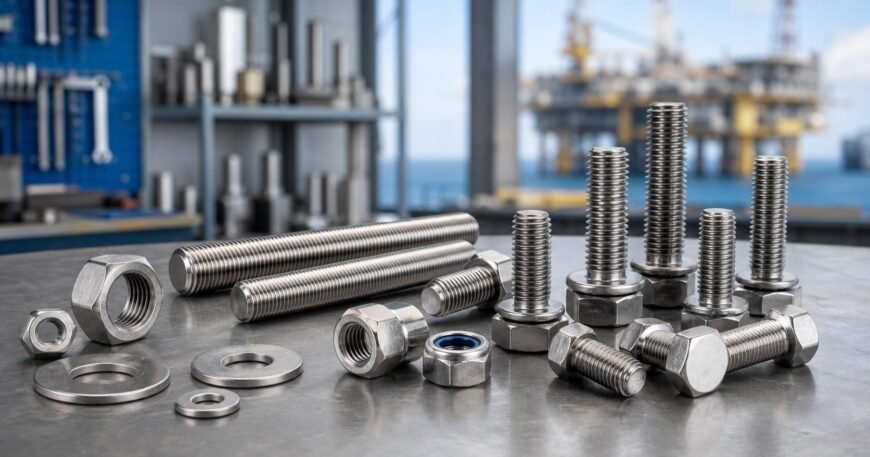
Industrial bolts and nuts are essential fastening components used across construction, oil and gas, petrochemical, marine, manufacturing and infrastructure projects. They provide mechanical connections between structural members, machinery, equipment and industrial assemblies. Selecting suitable fastening components is important for achieving the specified strength, dimensional compatibility and operational performance of an installation.
For procurement managers, EPC contractors, construction companies and industrial buyers searching for an Industrial Bolts and Nuts Supplier in Saudi Arabia, choosing the right products involves more than identifying the required dimensions. Material grades, mechanical properties, thread compatibility, corrosion resistance and applicable engineering standards must also be considered.
Saudi Arabia’s industrial sector has significant procurement requirements across Dammam, Al Khobar, Jubail and other commercial and industrial centres. Businesses operating in these locations require fastening materials for steel fabrication, pipeline installations, equipment assembly, plant maintenance and construction projects.
This guide explains the different types of industrial bolts and nuts, their applications, material considerations and important factors to evaluate when sourcing fastening products for industrial projects in Saudi Arabia.
Table of Contents
Understanding Industrial Bolts and Nuts
Bolts and nuts are mechanical fastening components designed to create secure connections between two or more parts. A bolt generally has an externally threaded shaft and a head, while a nut has an internally threaded opening that engages with a compatible bolt or threaded stud.
When correctly selected and installed, bolted connections can provide strong, maintainable and, where designed accordingly, removable mechanical joints.
Industrial fastening requirements vary according to the application. A steel fabrication project may require high-strength structural bolts, while an oil and gas installation may specify particular bolting materials for flange connections and industrial equipment.
1. Hex Bolts
Hex bolts are among the most commonly used industrial fastening products. They feature a hexagonal head that allows tightening using suitable tools.
Applications include:
- Industrial machinery assembly.
- Steel fabrication and structural connections.
- Construction equipment installation.
- Manufacturing operations.
- General mechanical assemblies.
Hex bolts are available in different dimensions, materials and property classes. Their suitability depends on the engineering specification and intended application.
2. Heavy Hex Bolts
Heavy hex bolts have larger hexagonal heads than standard hex bolts of comparable nominal diameter.
They are commonly associated with structural steel connections and other applications requiring specified high-strength bolting assemblies.
Procurement teams should verify the applicable specification, bolt grade, dimensions, coating requirements and compatible nut and washer requirements.
ASTM F3125/F3125M is an important specification covering certain high-strength structural bolt assemblies made from quenched and tempered steel and alloy steel.
3. Stud Bolts
Stud bolts are threaded fasteners that are commonly used with nuts at one or both ends, depending on their configuration and application.
They are widely encountered in:
- Pipeline and flange connections.
- Oil and gas installations.
- Pressure equipment assemblies.
- Petrochemical facilities.
- Industrial maintenance operations.
Stud bolt selection requires attention to diameter, length, thread type, material specification and operating conditions.
4. Hex Nuts
Hex nuts have six external sides and an internally threaded opening. They are designed to work with compatible threaded fasteners.
Common applications include:
- Structural steel assemblies.
- Industrial machinery.
- Equipment installation.
- Pipeline support systems.
- Construction and fabrication.
Nut dimensions, property class and thread compatibility should be checked against the corresponding bolt specification.
5. Heavy Hex Nuts
Heavy hex nuts have larger dimensions than standard hex nuts and are commonly specified for particular structural and industrial bolting applications.
Their use depends on the required bolt assembly and engineering specification.
For high-strength applications, the bolt and nut should be selected as a compatible assembly rather than independently based on appearance or nominal diameter.
6. Washers and Fastening Accessories
Washers are commonly installed between a nut or bolt head and the connected surface.
Depending on their design, they can distribute bearing loads, protect contact surfaces or perform specialised locking functions.
Common examples include:
- Flat washers.
- Hardened washers.
- Spring washers.
- Locking washers.
- Wedge-lock washers.
For industrial procurement, washers should be selected according to the fastener assembly and the relevant engineering requirements.
Types of Materials Used in Industrial Bolts and Nuts
Material selection affects the mechanical properties, corrosion resistance and suitability of fastening products for different operating environments.
Carbon Steel
Carbon steel fasteners are widely used in general construction, manufacturing and industrial applications.
They are available in different grades and property classes. The appropriate selection depends on the mechanical requirements and relevant product specification.
Surface protection may be required where the operating environment creates corrosion risks.
Alloy Steel
Alloy steel fasteners are used in applications requiring particular combinations of strength and mechanical properties.
Their selection depends on the specified chemical composition, heat treatment, mechanical properties and service conditions.
They are commonly considered for demanding industrial and structural applications where the engineering specification requires particular material characteristics.
Stainless Steel
Stainless steel bolts and nuts are often selected where corrosion resistance is an important requirement.
Potential applications include:
- Marine engineering.
- Coastal infrastructure.
- Industrial equipment.
- Chemical processing environments.
- Outdoor installations.
Different stainless steel grades have different properties. Buyers should consider the actual exposure conditions, temperature, loading and compatibility with connected materials.
Galvanized and Coated Fasteners
Fasteners may be supplied with protective coatings or finishes depending on their intended application.
Examples include hot-dip galvanizing and other specified protective treatments.
The selection of a coating should consider the environment, dimensional requirements, thread compatibility and relevant product standard. Coating thickness and process requirements should be confirmed before procurement.
Important Standards for Industrial Bolts and Nuts
Industrial fastening materials are frequently purchased according to recognised international and project-specific standards.
Understanding the relevant standards helps procurement teams communicate technical requirements accurately.
ISO 898-1: Bolts, Screws and Studs
ISO 898-1 specifies mechanical and physical properties for carbon steel and alloy steel bolts, screws and studs within its defined scope.
The published ISO 898-1:2013 edition remains the current published edition as confirmed by ISO in 2025, although a replacement is under development.
It is important to verify the applicable edition when preparing procurement specifications.
Reference: https://www.iso.org/standard/60610.html
ISO 898-2: Nuts
ISO 898-2:2022 specifies mechanical and physical properties for nuts manufactured from non-alloy and alloy steel within its defined scope.
It includes specified nut property classes and dimensional and thread requirements.
This standard is particularly relevant when matching nuts with compatible bolts and studs.
Reference: https://www.iso.org/standard/79349.html
ASTM F3125/F3125M: High-Strength Structural Bolts
ASTM F3125/F3125M covers specified high-strength structural bolts and assemblies manufactured from quenched and tempered steel and alloy steel.
It addresses requirements including mechanical properties, materials, dimensions, testing, marking and quality assurance.
It is intended for particular structural bolting applications and should not be treated as a universal specification for all industrial bolts.
Reference: https://store.astm.org/f3125_f3125m-25.html
ASTM Specifications for Nuts and Other Fastening Components
Other ASTM specifications may apply to particular nut, washer and industrial fastening products.
For example, ASTM A563/A563M addresses carbon and alloy steel nuts, while ASTM F436/F436M addresses hardened steel washers for specified applications.
The correct specification should be identified from the project drawings, approved material list and engineering documentation.
Industrial Applications of Bolts and Nuts in Saudi Arabia
Saudi Arabia’s construction, energy, manufacturing and marine sectors require different types of industrial fastening components.
Oil and Gas Industry
Bolts and nuts are used in equipment assemblies, pipeline connections, flange arrangements, structural supports and plant maintenance.
Fasteners used in critical connections must meet the specified material, mechanical and dimensional requirements.
Procurement teams should verify the applicable bolting specifications, operating temperature, pressure-related design requirements and material compatibility.
Construction and Steel Fabrication
Construction projects require fastening components for structural steel connections, building frameworks, equipment foundations and fabricated assemblies.
High-strength structural bolts, compatible nuts and washers may be specified for particular steel connections.
The connection design and applicable structural standards should determine the product requirements.
Petrochemical and Chemical Manufacturing
Petrochemical and chemical facilities use fastening products in equipment installations, mechanical assemblies, plant infrastructure and maintenance operations.
Material selection should consider the potential exposure to chemicals, temperature variations and other environmental conditions.
Marine and Shipbuilding
Marine applications can expose fastening components to moisture, salt and corrosive environments.
Stainless steel or other corrosion-resistant materials may be considered depending on the application.
However, buyers should evaluate the complete operating environment and material compatibility before specifying a fastener.
Industrial Manufacturing and Maintenance
Manufacturing facilities require bolts and nuts for machinery installation, production equipment, structural assemblies and maintenance activities.
Maintaining accurate records of dimensions, material specifications and replacement requirements can help procurement teams source compatible components.
How to Select the Right Industrial Bolts and Nuts
Before purchasing industrial fastening materials in Saudi Arabia, procurement teams should evaluate several technical requirements.
1. Confirm the Required Bolt Type
Identify whether the application requires hex bolts, heavy hex bolts, stud bolts, structural bolts or another specialised fastener.
Product selection should be based on the engineering drawings and connection design.
2. Verify Dimensions and Thread Specifications
Confirm the following details:
- Nominal diameter.
- Overall length.
- Thread pitch.
- Thread series.
- Thread tolerance.
- Head dimensions.
- Nut dimensions.
- Required washer dimensions.
Metric and imperial threads should not be mixed unless the engineering design specifically permits the combination.
3. Match Bolt and Nut Property Classes
A compatible bolt and nut assembly is essential for achieving the intended mechanical performance.
The nut property class must be appropriate for the corresponding bolt and the applicable standard.
Do not assume that nuts and bolts with identical nominal diameters are automatically compatible.
4. Consider Corrosion and Environmental Conditions
Consider whether the installation will be exposed to:
- Saltwater or coastal atmospheres.
- Moisture and humidity.
- Industrial chemicals.
- High or low temperatures.
- Outdoor weather conditions.
- Dissimilar metals.
The material and protective coating should be selected according to the service environment.
5. Confirm Documentation Requirements
Depending on project requirements, buyers may need:
- Material Test Certificates.
- Manufacturer’s test reports.
- Mechanical property documentation.
- Chemical composition records.
- Dimensional inspection reports.
- Coating inspection records.
- Product traceability information.
Documentation should be agreed upon before ordering, particularly for critical industrial and EPC projects.
Common Procurement Mistakes When Buying Industrial Bolts and Nuts
Several purchasing mistakes can create installation problems, delays and additional costs.
Selecting products only by price: Low-cost products may not meet the required engineering specification or documentation requirements.
Ignoring thread compatibility: Incorrect thread pitch or thread series can prevent proper assembly.
Mixing bolt and nut grades: Incompatible mechanical property classes can affect the intended performance of the fastening assembly.
Overlooking corrosion exposure: A material suitable for an indoor installation may not be appropriate for coastal or marine environments.
Using outdated specifications: Procurement teams should verify the applicable standard and edition rather than relying on old purchase records.
Not confirming quantities and dimensions: Incomplete purchase enquiries can result in quotation errors and procurement delays.
How to Choose an Industrial Bolts and Nuts Supplier in Saudi Arabia
Finding a suitable industrial bolts and nuts supplier requires evaluating product availability, technical understanding and procurement support.
Product Range and Category Coverage
Check whether the supplier offers the required fastening categories, including bolts, nuts, washers, stud bolts and related accessories.
A broader product catalogue can help buyers consolidate procurement enquiries across different fastening requirements.
Technical Specification Understanding
The supplier should be able to review the requested product description, dimensions, material grades and applicable standards.
For critical applications, technical approval should remain with the responsible engineering team.
Quality Documentation
Ask whether the supplier can provide the documentation required by the purchase order, such as material certificates, inspection reports and product traceability records.
Quotation and Procurement Communication
A clear quotation should identify the product description, specification, quantity, pricing, delivery terms and documentation requirements.
Regional Procurement Support
Companies sourcing materials for projects in Dammam, Al Khobar, Jubail and other Saudi industrial locations should confirm the supplier’s actual delivery coverage, order coordination arrangements and lead times.
How Zabar Global Supports Industrial Fastener Procurement
Zabar Global Company supplies construction, oil and gas drilling and lifting materials, serving customers across the Middle East and African regions.
Its website features a dedicated Fasteners Materials category containing stud bolts, anchor bolts, U-bolts and related fastening products.
The online catalogue also features a Bolts, Nuts & Washers category with 108 listed products.
Explore Bolts, Nuts and Related Fastening Products
Businesses can explore Zabar Global’s online catalogue to identify relevant fastening categories and products.
The product portfolio includes:
- Bolts and nuts.
- Stud bolts.
- Anchor bolts.
- U-bolts.
- Washers.
- Wedge-lock washers.
- Blind rivet nuts.
- Other fastening accessories.
Explore the Bolts, Nuts & Washers product category and the wider Fasteners Materials catalogue.
Supporting Industrial and Construction Procurement
Zabar Global’s wider industrial materials portfolio serves procurement requirements across construction, oil and gas, marine and engineering sectors.
For companies operating in Saudi Arabia, Zabar Global lists a Saudi contact location in Al Jubail on the Jubail–Dammam Highway.
Businesses can contact the company to discuss product specifications, quantities and project procurement requirements.
Request a Quotation for Industrial Bolts and Nuts
When submitting a quotation enquiry, include:
- Required bolt or nut type.
- Material and property class.
- Applicable ASTM, ISO or project standard.
- Diameter and length.
- Thread specifications.
- Required quantity.
- Documentation requirements.
- Project location and delivery timeline.
Providing these details helps the supplier understand the requirement and respond with a more relevant quotation.
Visit Zabar Global to explore its industrial product portfolio and discuss your fastening material requirements.
Frequently Asked Questions
1. Where can I find an industrial bolts and nuts supplier in Saudi Arabia?
Businesses can explore Zabar Global’s Fasteners Materials catalogue, which includes bolts, nuts, washers, stud bolts and other fastening products. Contact the company to confirm specifications, availability and delivery arrangements for your project.
2. What types of industrial bolts are commonly used in Saudi Arabia?
Commonly specified types include hex bolts, heavy hex bolts, structural bolts and stud bolts. The appropriate product depends on the connection design, material requirements and applicable engineering standards.
3. What is the difference between a hex bolt and a heavy hex bolt?
Both have hexagonal heads, but heavy hex bolts have larger head dimensions. They are commonly specified for particular structural and industrial bolting applications. The correct type should be selected according to the relevant product specification.
4. Which standards apply to industrial bolts and nuts?
Relevant standards include ISO 898-1 for specified carbon and alloy steel bolts, screws and studs, ISO 898-2 for specified carbon and alloy steel nuts, and ASTM F3125/F3125M for certain high-strength structural bolts and assemblies.
5. How do I select the right material for industrial bolts and nuts?
Consider mechanical loading, corrosion exposure, temperature, chemical contact, connected materials and project specifications. Carbon steel, alloy steel and stainless steel each have different properties and application requirements.
6. What information is required to request a bolt and nut quotation?
Provide the product type, material grade, applicable standard, dimensions, thread details, quantity, required certificates and delivery location. Drawings and technical datasheets can help clarify the requirements.
Conclusion
Industrial bolts and nuts play an important role in construction, oil and gas, petrochemical, marine, manufacturing and infrastructure projects throughout Saudi Arabia.
Selecting suitable fastening products requires careful attention to bolt types, nut compatibility, material properties, mechanical grades, dimensions and applicable standards.
For procurement teams searching for an Industrial Bolts and Nuts Supplier in Saudi Arabia, evaluating product categories, documentation requirements and supplier communication can help simplify industrial sourcing.
Zabar Global offers a range of fastening products through its Fasteners Materials catalogue, supporting procurement requirements across construction, energy and industrial applications.
Explore the Zabar Global Bolts, Nuts & Washers catalogue or visit zabarglobal.com to discuss your industrial fastening requirements.
Zabar Global – Supporting Industrial Procurement Across the Middle East and African Markets.