


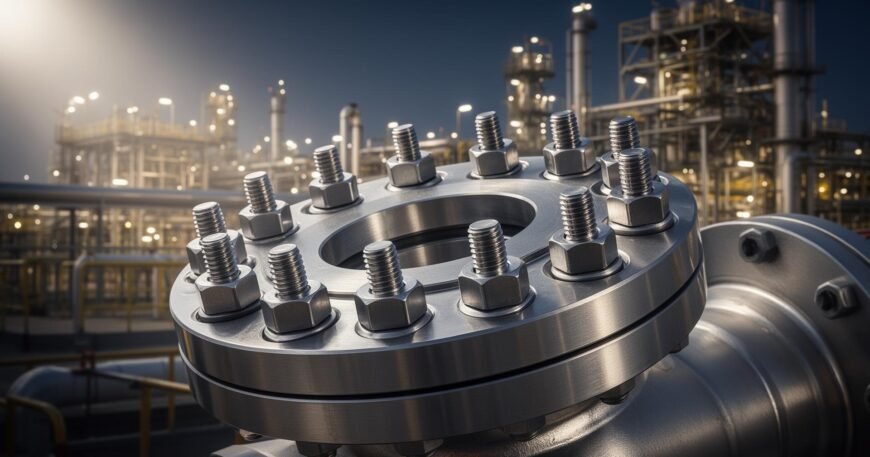
Oil and gas facilities depend on reliable bolted connections to join pipes, flanges, valves, pressure equipment and other critical components. In these applications, selecting the correct stud bolts and heavy hex nuts is an important part of equipment specification, installation and maintenance.
From refineries and petrochemical plants to pipelines and industrial processing facilities, bolting components must be selected according to the engineering specification, operating conditions, material requirements and applicable standards.
For procurement teams, contractors and maintenance professionals in Saudi Arabia, understanding stud bolt assemblies can help improve purchasing accuracy and reduce the risk of ordering components that do not match project requirements.
This guide explains the purpose of stud bolts and heavy hex nuts, commonly referenced ASTM specifications, material and grade considerations, flange bolting requirements and the key details to confirm before placing an industrial order.
Table of Contents
What Are Stud Bolts?
A stud bolt is a threaded fastener designed to be used with nuts to create a bolted connection. Depending on the design and application, it may have threads along its full length or specified threaded portions with an unthreaded section between them.
Stud bolts are commonly used in flange connections, pressure equipment, pipelines, valves and industrial assemblies where a secure, serviceable bolted joint is required.
Unlike a conventional headed bolt, a stud bolt does not rely on an integral bolt head. It is installed with nuts, allowing the connected components to be tightened together according to the applicable assembly procedure.
Common Stud Bolt Configurations
The configuration required depends on the equipment design and project specification.
Fully threaded studs: These have threads along the entire length and are used where the specified connection requires a fully threaded fastener.
Stud bolts with specified thread lengths: These have defined threaded sections and may include an unthreaded central portion, depending on the design and purchase specification.
Custom-length stud bolts: Certain projects require specified lengths, diameters, thread forms or finishes to suit the flange or equipment arrangement.
The required configuration should always be confirmed against the engineering documents rather than selected by appearance alone.
What Are Heavy Hex Nuts?
Heavy hex nuts are hexagonal nuts with a heavier profile than standard hex nuts. They are used with compatible bolts or studs to form bolted connections.
Their larger external dimensions provide a different bearing and wrenching profile from standard hex nuts. However, the correct nut is not selected on dimensions alone. Its material grade, mechanical properties, thread dimensions and compatibility with the mating stud bolt must also meet the project specification.
In industrial flange bolting, heavy hex nuts may be specified as part of a stud bolt assembly. The purchase order should clearly identify the required nut specification and grade.
Why Are Stud Bolts and Heavy Hex Nuts Used in Oil and Gas Projects?
Oil and gas facilities contain extensive piping systems, process equipment and mechanical connections. Many of these assemblies use flanged joints that require correctly specified bolting components.
Stud bolts and heavy hex nuts are selected for applications such as:
1. Pipeline and Flange Connections
Flanged joints connect pipe sections, valves, fittings and equipment. Stud bolts and nuts are selected to match the flange design, pressure class, dimensions, materials and project requirements.
2. Refineries and Petrochemical Facilities
Refineries and petrochemical plants operate with different process fluids, temperatures and pressures. Bolting requirements must therefore be evaluated for the particular service conditions and equipment specification.
3. Pressure Vessels and Process Equipment
Pressure equipment may use bolted connections that require carefully specified fastener materials and mechanical properties. The applicable design code, equipment documentation and purchase specification should determine the required components.
4. Valve and Mechanical Equipment Assemblies
Valves and other industrial equipment may use bolted connections for installation, maintenance and replacement. Correct dimensions, thread compatibility and material identification are essential when procuring replacement fasteners.
5. Maintenance and Shutdown Projects
Industrial maintenance and shutdown activities often require replacement bolting. Procurement teams should use equipment records, drawings, original specifications and approved material requirements to identify the correct replacement components.
Common ASTM Specifications for Stud Bolts and Heavy Hex Nuts
ASTM specifications are frequently referenced in industrial bolting documents. Two important specifications to understand are ASTM A193/A193M and ASTM A194/A194M.
The exact applicable edition and supplementary requirements must be confirmed against the project documents and the latest approved specification.
ASTM A193/A193M for Bolting Materials
ASTM A193/A193M covers alloy-steel and stainless-steel bolting materials for high-temperature service. Its scope includes various forms of bolting material, such as studs and stud bolts, for applications including pressure vessels, valves, flanges and fittings.
The specification includes different material grades. The required grade depends on the application and engineering requirements.
ASTM A193 Grade B7 is a commonly referenced chromium-molybdenum alloy-steel bolting grade in industrial applications. It should not be treated as a universal selection for every oil and gas service.
Other grades may be required where the service conditions, corrosion considerations, temperature requirements or project specifications call for different materials.
ASTM A194/A194M for Nuts
ASTM A194/A194M covers carbon-steel, alloy-steel and stainless-steel nuts intended for high-pressure or high-temperature service, or both.
ASTM A194 Grade 2H is a commonly specified heavy hex nut grade used in certain industrial bolting assemblies. The purchaser should verify that the grade and dimensions match the specified stud bolt and application.
ASTM A194/A194M-26 is listed by ASTM as an active 2026 edition. Always confirm the edition stated in the purchase specification rather than automatically substituting the newest edition.
Understanding the B7 and 2H Combination
ASTM A193 Grade B7 stud bolts and ASTM A194 Grade 2H nuts are a commonly referenced combination in industrial bolting specifications.
However, a B7 and 2H combination must not be assumed suitable for every flange connection or operating environment. The project specification may require another grade, supplementary testing, special material controls or different corrosion and service requirements.
The complete assembly must be evaluated for compatibility, mechanical requirements and the intended operating conditions.
B7 vs B7M: What Is the Difference?
B7 and B7M are different grades referenced under ASTM A193/A193M. They should not be treated as interchangeable.
B7 is a chromium-molybdenum alloy-steel bolting grade used in specified high-temperature and pressure-related applications.
B7M is a modified grade with additional requirements associated with hardness and material control. It may be specified for particular service environments, including certain sour-service applications, when required by the governing project specification.
The selection of B7 or B7M must be made by the responsible engineering team based on the applicable material specification and service conditions.
For sour environments, buyers should also verify the applicable project requirements and relevant materials standards. Do not assume that choosing a B7M designation alone establishes compliance with all sour-service requirements.
Important Factors When Selecting Stud Bolts and Heavy Hex Nuts
Before ordering industrial bolting components, confirm the following information.
1. Material Grade
Identify the exact stud bolt and nut grades stated in the project specification. Confirm that both components are compatible and that any supplementary requirements are included.
2. Diameter and Length
Specify the required nominal diameter, overall length, thread length and any relevant dimensional requirements. Do not estimate dimensions from an old or unidentified fastener.
3. Thread Specification
Confirm the thread form, pitch, series and tolerance requirements. The stud bolt and nut must have compatible threads.
4. Operating Temperature and Pressure
Review the intended operating conditions and equipment requirements. The fastener material must be suitable for the specified application.
5. Corrosion and Environmental Conditions
Consider the process environment, exposure conditions, moisture, chemicals and other corrosion risks. Where necessary, confirm material and coating requirements with the engineering team.
6. Applicable Standards and Supplementary Requirements
Check the standards and editions stated in the project documents. Some projects include additional requirements for inspection, testing, traceability, marking or documentation.
7. Inspection and Documentation
Confirm which documents are required before placing the order. Depending on the project, these may include material test certificates, inspection reports, dimensional verification and other quality records.
Flange Bolting: Why Correct Specification Matters
A flange connection is an engineered assembly. Its performance depends on more than the quality of an individual stud bolt or nut.
The flange, gasket, bolting components, installation method and tightening procedure must work together according to the applicable design and project requirements.
ASME B16.5 addresses pipe flanges and flanged fittings and includes requirements and recommendations relating to flange bolting, gaskets and flange joints within its scope.
When procuring flange bolting, confirm:
- Flange size and pressure class
- Required stud bolt diameter and length
- Nut type, dimensions and grade
- Gasket and flange arrangement
- Material compatibility
- Project-specific installation and tightening procedure
- Inspection and documentation requirements
Do not select fasteners using flange size alone. The approved drawings, equipment data and project specification should determine the complete bolting assembly.
Procurement Checklist for Oil and Gas Stud Bolts
Procurement teams can use the following checklist when preparing an enquiry or purchase order.
| Requirement | Information to confirm |
|---|---|
| Product | Stud bolt and heavy hex nut |
| Standard | Applicable ASTM or project specification |
| Stud bolt grade | Exact grade required |
| Nut grade | Exact grade required |
| Diameter | Nominal size |
| Length | Required overall length |
| Thread | Thread form, pitch and tolerance |
| Quantity | Required quantity and spare allowance |
| Finish | As specified by the project |
| Testing | Required inspection and testing |
| Documentation | Required material and quality records |
| Delivery | Required delivery location and schedule |
Providing complete information helps suppliers assess the enquiry accurately and reduces clarification during procurement.
Choosing an Industrial Fastener Supplier in Saudi Arabia
Selecting an industrial fastener supplier involves more than comparing prices. Oil and gas procurement teams should assess whether the supplier can understand the enquiry, identify the specified products and provide the documentation required for the order.
Important evaluation points include:
- Product range relevant to the enquiry
- Ability to review technical specifications
- Clear confirmation of material grades and dimensions
- Availability of required quality documentation
- Transparent quotation and delivery communication
- Experience handling industrial procurement requirements
For a broader overview of supplier evaluation and industrial fastener categories, read our guide to the Best Fasteners Supplier in Dammam, Al Khobar & Saudi Arabia.
Zabar Global lists stud bolts, anchor bolts, U-bolts and related accessories within its Fasteners Materials category. Buyers can review the product category and contact the company to discuss their specific requirements.
For enquiries, provide the relevant drawings, material specifications, sizes, quantities and documentation requirements so that the requested products can be assessed accurately.
Frequently Asked Questions
1. What are stud bolts used for in oil and gas projects?
Stud bolts are used in bolted connections such as pipeline flanges, valves, pressure equipment and industrial assemblies. The required type and grade depend on the equipment design and project specification.
2. What is the difference between a stud bolt and a regular bolt?
A conventional bolt generally has an integral head and a threaded portion. A stud bolt is a threaded fastener used with nuts and may be threaded along its full length or in specified sections.
3. What is ASTM A193 Grade B7?
ASTM A193 Grade B7 is a chromium-molybdenum alloy-steel bolting grade used in specified industrial applications. The applicable standard edition and project requirements should be checked before ordering.
4. What is ASTM A194 Grade 2H?
ASTM A194 Grade 2H is a nut grade referenced in industrial bolting specifications. Its suitability depends on the mating stud bolt, application and governing project requirements.
5. Can B7 stud bolts be used with 2H heavy hex nuts?
B7 stud bolts and 2H heavy hex nuts are a commonly referenced combination. However, buyers must confirm the required grades, dimensions, compatibility and supplementary requirements in the approved project specification.
6. Are B7 and B7M interchangeable?
No. They are different ASTM A193 grades with different requirements. The responsible engineering team should determine the correct grade for the application.
7. What information should be included in a stud bolt enquiry?
Include the applicable standard and edition, stud bolt and nut grades, diameter, length, thread details, quantity, finish, testing requirements and required documentation.
8. Where can I enquire about stud bolts in Saudi Arabia?
You can review Zabar Global’s Fasteners Materials category and contact the company with your technical requirements for an enquiry.
Conclusion
Stud bolts and heavy hex nuts are important components in industrial bolted connections used across oil and gas, petrochemical, pipeline and process facilities.
Successful procurement starts with accurate technical information. Confirm the material grades, dimensions, thread details, applicable standards, operating conditions and documentation requirements before placing an order.
For industrial fastener procurement in Saudi Arabia, explore Zabar Global’s Fasteners Materials category or contact the company to discuss your project requirements.
Explore: Zabar Global Fasteners Materials
Contact: Zabar Global